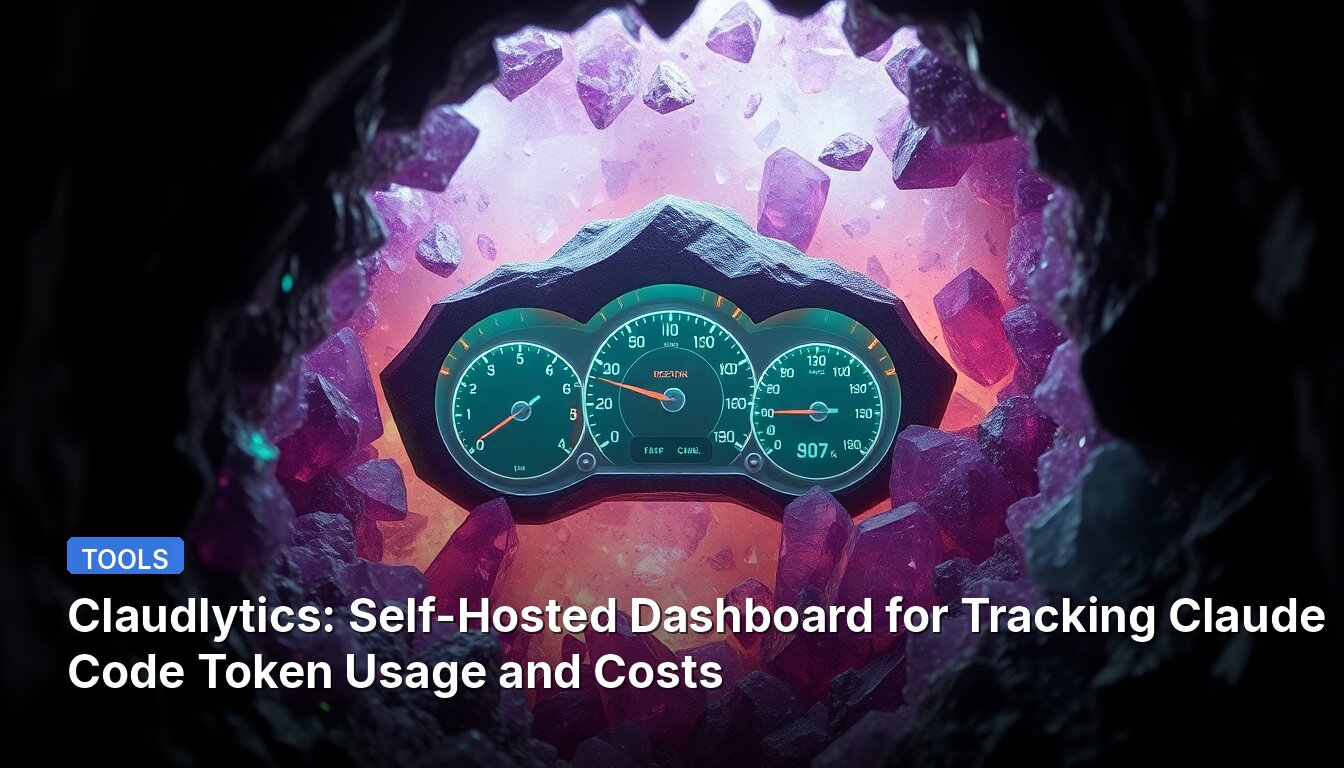
Claudlytics: Self-Hosted Dashboard for Tracking Claude Code Token Usage and Costs
What Claudlytics Does
Claudlytics is a self-hosted dashboard that tracks Claude Code token usage and costs in real time. It's specifically useful for developers running Claude Code headlessly on remote VPS or servers where the desktop app's local machine tracking isn't sufficient.
How It Works
Claude Code writes every conversation to ~/.claude/projects/**/*.jsonl files. Claudlytics reads these files, parses the token usage, and calculates costs using Sonnet 4.6 pricing. No Claude API calls are needed for basic usage — everything is processed locally.
Dashboard Features
- Current session token counts and cost
- Rolling 5-hour window usage with reset countdown (aligns with Claude Pro/Max session limits)
- Today / Last 7 days / Billing cycle breakdowns
- Session and weekly message counts
Setup and Installation
Setup requires three commands:
git clone https://github.com/iansugerman/Claudlytics.git
cd Claudlytics
node server.js
After running these commands, open http://localhost:3031 in your browser.
Security and Remote Access
The server binds to 127.0.0.1 only, so it's never publicly exposed. For remote server access, use an SSH tunnel:
ssh -L 3031:localhost:3031 user@your-serverThen browse to localhost:3031 on your local machine.
Production Deployment
Claudlytics can run as a systemd service for background availability. Full instructions are available in the GitHub repository's README.
📖 Read the full source: r/ClaudeAI
👀 See Also
Open-source AI job search system built with Claude Code evaluates offers, generates tailored resumes
A developer open-sourced a Claude Code project that turns your terminal into a job search command center. The system evaluates job offers across 10 dimensions, generates ATS-optimized PDF resumes, scans 45+ company career pages, and includes 14 skill modes.

Code retrieval for AI agents: Why vector embeddings fail and per-file LLM graphs win
After a year of building a code indexing system, the team behind Bytebell found that vector embeddings on code chunks and Tree-sitter ASTs both fell short, while per-file LLM summaries stored in a Neo4j graph with semantic fulltext search significantly improved retrieval precision.
Zikra: Self-Hosted MCP Memory Server for Claude Code, Cursor, and Codex
Zikra is a self-hosted MCP memory server that automatically saves every decision, error, and requirement when Claude Code sessions end via a Stop hook, creating a shared memory pool accessible across tools and team members.

BrightBean Studio: Open-source social media management platform built with AI agents
BrightBean Studio is an open-source, self-hostable social media management platform that supports 10+ platforms with direct first-party API integrations. It was built in 3 weeks using Claude and Codex.